 Acrossv2
 root bundles and proofs for relayer refunds
Acrossv2 grouped relayer refunds and pool rebalances into root bundles, which committed to settlement actions across supported chains. An undisputed bundle could support execution after its challenge window ended, with Merkle proofs connecting individual actions to its roots. Relayers had already supplied the recipient's funds; the later refund restored their capital. V2 is deprecated, and V3 changed the relevant events and relayer interface. A proposed root alone did not establish that a relayer had received repayment.
A valid fill created a repayment obligation
A valid destination-chain fill established the relayer's contribution for later reimbursement under the protocol's settlement rules. The bridge recipient received the transferred assets through that fill. The relayer's own repayment belonged to a later part of the process, using liquidity that the system managed across its pools.
The deposit supplied the transfer instruction, including its destination chain. The fill recorded the relayer's contribution toward that instruction. Settlement then needed to account for the contribution and arrange repayment. A proposer posted a bond to submit those repayment and rebalance commitments to the HubPool on Ethereum.
V2 also permitted partial fills. That feature concerned delivery of the requested transfer, while root bundles governed subsequent settlement obligations.
A delivered transfer established that the recipient had obtained funds. It did not establish that the relayer had recovered its capital. The refund required its own execution within the settlement system.
When could a root bundle support a relayer refund?
An undisputed V2 root bundle could support included transfers after its liveness period ended. That period gave other participants an opportunity to challenge the proposed settlement information.
The waiting period applied to the bundle's optimistic validation. It did not measure the recipient's transfer time or promise a fixed reimbursement deadline. A refund still needed its root stored in the pool on the repayment chain, an included instruction with a valid Merkle proof, and enough tokens for execution. Elapsed time alone established none of those other conditions.
Separate roots kept settlement actions distinct
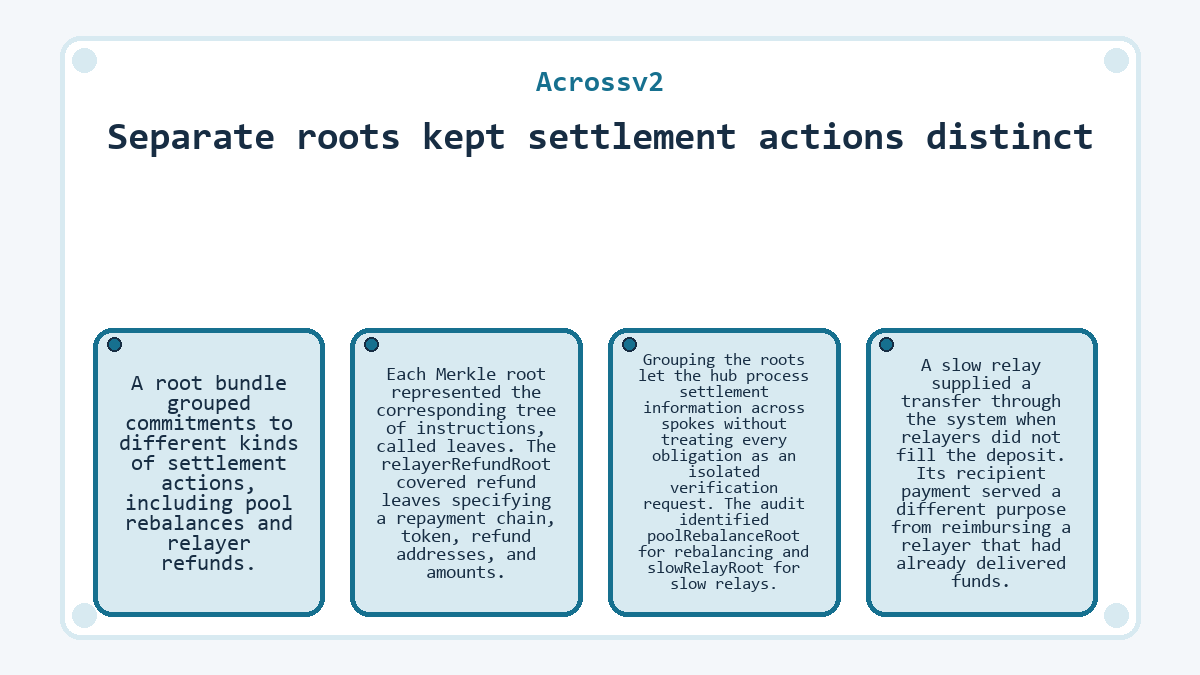
A root bundle grouped commitments to different kinds of settlement actions, including pool rebalances and relayer refunds. Each Merkle root represented the corresponding tree of instructions, called leaves. The relayerRefundRoot covered refund leaves specifying a repayment chain, token, refund addresses, and amounts. Grouping the roots let the hub process settlement information across spokes without treating every obligation as an isolated verification request. The audit identified
poolRebalanceRoot
for rebalancing and
slowRelayRoot
for slow relays. A slow relay supplied a transfer through the system when relayers did not fill the deposit. Its recipient payment served a different purpose from reimbursing a relayer that had already delivered funds.
What the Merkle proof established
A Merkle proof connected an individual instruction to a root that the bundle committed to. That connection supported execution of the included action after the applicable validation conditions. It did not independently decide whether the bundle's underlying settlement claims followed the protocol's rules.
The tree commitment and its proof answered an inclusion question: did this instruction belong to this root? Optimistic validation addressed the proposed bundle's acceptability. The audited SpokePool checked that the refund leaf's chain ID matched its own. It also verified the proof against the stored refund root and rejected leaves already claimed for that bundle.
The contracts also needed the action's chain and token context. An instruction that referred to one spoke could not safely become permission to transfer funds from any spoke. The historical slow-relay finding demonstrated why execution needed that distinction.
Successful execution marked the leaf as claimed and paid its nonzero refunds. The ExecutedRelayerRefundRoot event recorded the token, refund addresses, and amounts.
Rebalances moved liquidity between pools
A hub-to-spoke rebalance moved funds from Ethereum's central hub to a spoke pool. The
HubPool
and the
SpokePool
contracts held funds and transferred them between chains. Chain-specific adapters provided a common interface for movements from the hub to the spokes. The audited HubPool also sent the bundle's refund and slow-relay roots to the specified spoke when it executed that chain's rebalance leaf.
A refund instruction and available liquidity played different roles. The instruction described an authorized payment; the pool balance supplied the assets. Root bundles could represent the needed rebalances alongside repayment obligations, while cross-chain transfers connected the relevant pools.
V2 parameters and their chain boundaries
The relevant parameters identified both the requested transfer and the later settlement conditions. Some described chains, while others governed the proposal's validation. The following roles belonged to the V2 design; they did not imply a universal bond amount or challenge-window duration.
| V2 parameter | Value or documented role | Applicable chain or state |
|---|---|---|
poolRebalanceRoot
|
Merkle root for pool rebalances | Rebalance leaves identified spoke chains |
slowRelayRoot
|
Merkle root for slow relays | Covered slow relays across the batch's spokes |
repaymentChainId
|
Relayer-selected repayment chain identifier | Validity depended on the token and supported chain |
destinationChainId
|
Deposit's requested destination identifier | Identified the recipient's delivery chain |
| Proposal bond | Amount controlled by the administrator | Applied to proposing root bundles |
| Liveness period | Window for disputing a proposed bundle | Preceded execution of an undisputed bundle |
The destination identifier concerned delivery, while
repaymentChainId
concerned reimbursement. Their different purposes made chain context essential even when both appeared in records associated with the same transfer. Token support also mattered: a chain identifier alone could not establish a valid repayment combination.
Invalid repayment IDs required an explicit rule
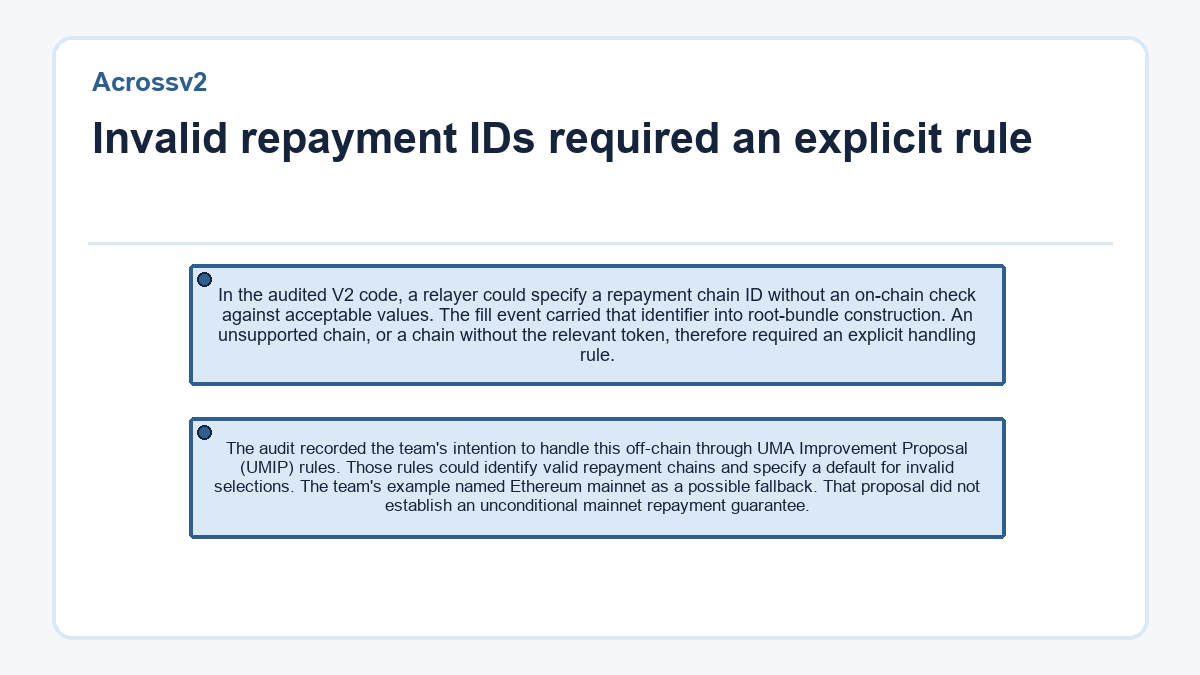
In the audited V2 code, a relayer could specify a repayment chain ID without an on-chain check against acceptable values. The fill event carried that identifier into root-bundle construction. An unsupported chain, or a chain without the relevant token, therefore required an explicit handling rule.
The audit recorded the team's intention to handle this off-chain through UMA Improvement Proposal (UMIP) rules. Those rules could identify valid repayment chains and specify a default for invalid selections. The team's example named Ethereum mainnet as a possible fallback. That proposal did not establish an unconditional mainnet repayment guarantee.
UMA governed the meaning of a dispute
When participants disputed a root bundle, UMA's optimistic oracle supplied the external dispute-resolution mechanism. At the time of the audit, the team planned to codify bundle-validity rules in UMIPs. OpenZeppelin's May 11, 2022 V2 audit excluded the UMIP rules from its audit scope. Reviewing the contracts therefore left a material part of settlement security outside that engagement.
The report treated those rules as a black box and described the oracle's authority over disputed outcomes. This separated two security questions: whether the contracts implemented their intended operations, and whether the external rules correctly determined valid settlement. The audit's documented fixes addressed specific code findings without removing that dependency.
Administrative choices affected settlement
The V2 administrator controlled enabled chains, permitted tokens, and token mappings between networks. That role also controlled proposal bonds, fee settings, and how disputed bundles were identified. These powers shaped which repayment instructions the system could support. The audit described a future intention to place the role under the UMA Governor contract; that intention alone did not establish a completed governance transfer.
Bundled validation and batched payments
V2 aggregated repayment verification so the oracle could assess a bundle together. V1 had involved the oracle each time it repaid a relayer. Grouping repayment claims reduced repeated verification work, while the dispute window remained part of settlement. Transaction batching addressed a separate cost input: it combined multiple payments into one transaction. Fewer separate payment transactions reduced their gas costs.
Destination-chain checks in the 2022 slow-relay fix
In the audited V2 implementation, a missing destination-chain filter could let a slow relay execute on the wrong spoke. Every spoke received the same
slowRelayRoot
, covering slow relays across the batch. A spoke with enough of the specified destination token could execute an instruction intended for another chain.
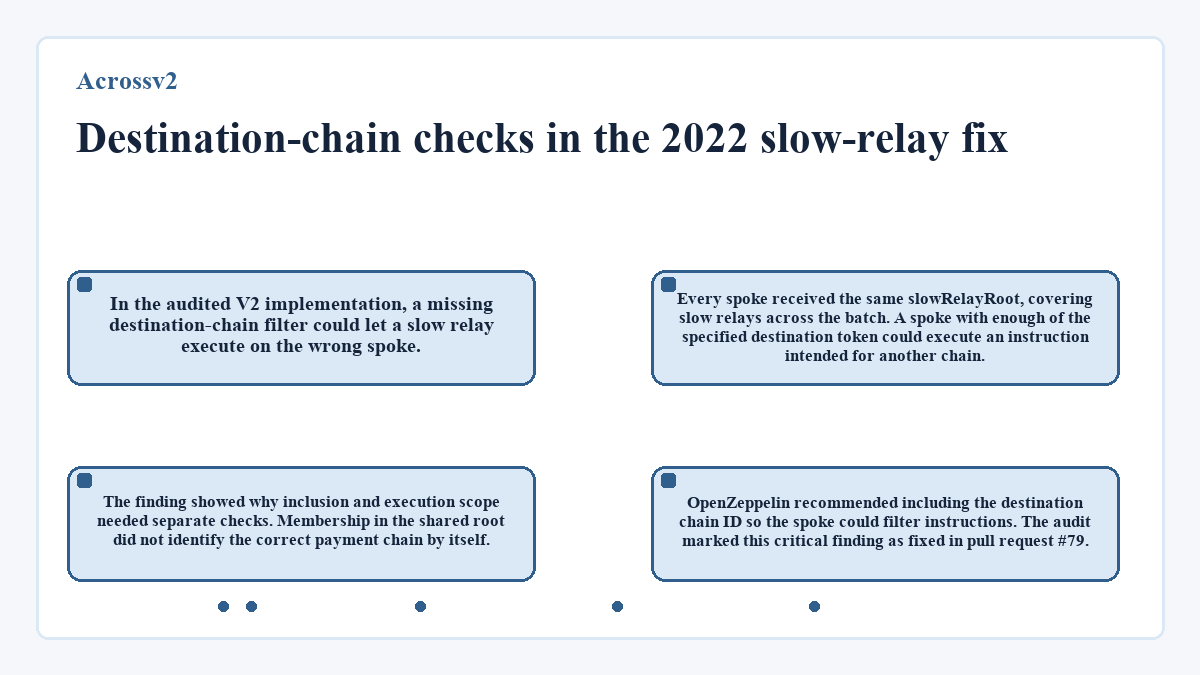
The finding showed why inclusion and execution scope needed separate checks. Membership in the shared root did not identify the correct payment chain by itself. OpenZeppelin recommended including the destination chain ID so the spoke could filter instructions. The audit marked this critical finding as fixed in pull request #79.
Still wondering about Acrossv2?
-
Which V2 events connected a deposit with its relayer fill?
- V2 used FundsDeposited for deposits and FilledRelay for fills. Those events described the transfer instruction and its delivery activity, providing inputs relevant to settlement. Neither event alone established that a relayer refund had executed. The V3 migration replaced them with V3FundsDeposited and FilledV3Relay. A settlement record therefore needed its version context before the event names could be interpreted correctly.
-
Was a depositor's speed-up signature proof of relayer repayment?
- No. A V2 depositor's speed-up signature authorized a change to the transfer's relay fee. That authorization concerned the terms for filling the transfer. It did not establish that a refund instruction belonged to a root bundle or that the protocol had reimbursed a relayer.
-
Could transfer fees or token hooks disrupt V2 repayments?
- Yes. The V2 audit warned that transfer-fee ERC-20 tokens could break assumptions that the transferred amount equaled the received amount. It separately identified ERC-777 transfer hooks that could revert. In the audited refund routine, one failing transfer could block the other refunds in that leaf. The report marked this warning as fixed in pull request #137. Token enablement remained part of the system's compatibility controls.
-
How did V3 change LP-fee calculation for relayer refunds?
- V3 moved liquidity-provider (LP) fee calculation to refund time using UMIP formulas. In V2, relayers had supplied the realizedLpFeePct value when filling a relay.
-
Did netting and root-bundle verification reduce the same work?
- Netting and root-bundle verification addressed different operations. Netting offset transfers in opposite directions, reducing the funds that needed to move. Root-bundle verification grouped settlement information so the optimistic oracle could validate repayment claims together. Both mechanisms contributed to V2's efficiency.
-
Which code revision did the May 2022 root-bundle audit examine?
- OpenZeppelin's May 11, 2022 audit examined commit bf03255cbd1db3045cd2fbf1580f24081f46b43a of the V2 contracts repository. The report also recorded fixes in separate pull requests. Its scope distinguished the initial code snapshot from changes that auditors subsequently reviewed.